SEO vs. Paid Ads: A Practical Decision Framework | MartGain
* SEO or Paid Ads: When Should a Business Use Each?. A practical MartGain guide to clarify the decision, check the evidence, and define a useful next step…

The short answer
A property firm or interior studio that posts only when someone has time usually does not have an idea problem. It has a shared-decision problem. A writer imagines one customer, a designer imagines another, and sales needs a page that answers a third question. The result is attractive content that does not explain the next step, landing pages that describe a service instead of a decision, and a calendar that stops after two weeks.
A useful content strategy turns that drift into a small operating system: a defined audience, a few durable themes, a usable voice guide, an editable calendar, and a review point that protects accuracy without freezing the team. To build it on one working brief, start with Content Strategy, then test the system against a real client decision instead of filling the calendar with generic titles. This guide is for property, real-estate, and interior teams in Egypt, Saudi Arabia, and the UAE. It offers a working method, not a promise of rankings, traffic, leads, or sales.
Start with the client decision
People rarely search for “content strategy” because they want a document. They are trying to decide something: Is this property suitable for my budget and location? Should I request a viewing? Can I trust this firm with a renovation? In an interior project, they want to imagine the result before sharing measurements or approving a scope.
Write the decision before you write a topic list. Examples include:
- A flat owner wants to know what to prepare before requesting an interior concept.
- An investor wants a fair comparison between two locations without relying on one promotional image.
- A family wants questions ready before a property viewing.
- A studio owner wants to know whether the current page explains the work clearly.
Each decision becomes a stronger theme than a broad phrase such as “real-estate tips.” When the decision changes, the evidence, visual, and next step should change with it.
Put the team map on one page
Use one page, not a large board. Give it six fields:
- Audience and sector: residential property, commercial property, fit-out, or interiors; who approves the next step?
- Current friction: price, trust, comparison, scope, or a missing piece of information.
- Practical promise: what will the reader understand or prepare after reading? Do not promise an outcome you cannot prove.
- Theme: a repeatable question such as comparing options, preparing for a viewing, or explaining the delivery stages.
- Output: an article, question sheet, comparison table, or checklist that someone can open and review.
- Owner and review point: who drafts, who checks the facts, and who decides whether to revise or release?
This prevents a common mismatch. A writer may produce a beautiful piece about kitchen materials while sales needs a page explaining the scope and approval stages. Both pieces can be useful, but they serve different decisions.
Choose three to five themes
Themes are not decorative categories. They are the questions your audience returns to. A property or interior team can start with the following structure and adjust it to the real operation.
1. Understanding the choice
Explain how a client can compare locations, layouts, or materials. Use checkable criteria: daily use, constraints, maintenance, and what changes the budget. Avoid absolute claims such as “always the best.”
2. Preparing for a viewing or meeting
Give readers the questions, measurements, and documents that make a meeting more useful. This works because it connects reading to a real action instead of repeating the service description.
3. Explaining the way work happens
Show the actual stages: requirements, first concept, review, approval, and handover. If a stage is outside the agreed scope, say so instead of adding it to make the process appear larger.
4. Reading a space and its materials
For interiors, explain how light, movement, storage, and materials affect a choice. Use simple diagrams or annotated plans when they teach something; decorative images alone are not enough.
5. Learning from a case
Use an anonymized case: the problem, the options, the decision, and what remained unknown. Do not publish client numbers, results, or private details without permission and a traceable source.
Write a voice guide people can actually use
A voice guide should not be a page of adjectives such as “professional and friendly.” Turn it into decisions:
- Start with the customer’s visible problem, then explain the term.
- Use plain language; keep an English term only when it removes confusion.
- Say “may” when the result depends on conditions. Do not turn an example into a guarantee.
- Use short sentences and headings that tell the reader what is inside.
- State what the decision does not include so expectations stay accurate.
- Choose images and examples that fit the market, property type, and stage of the decision.
Test the guide on one paragraph. Ask someone outside the writing team to answer: What is the problem? What should the reader do next? What remains undecided? If they cannot answer, refine the guide before producing more content.
Build a calendar that survives real work
A useful calendar does not fill every day. It starts with the team’s ability to gather information and review it. Try a simple monthly cycle:
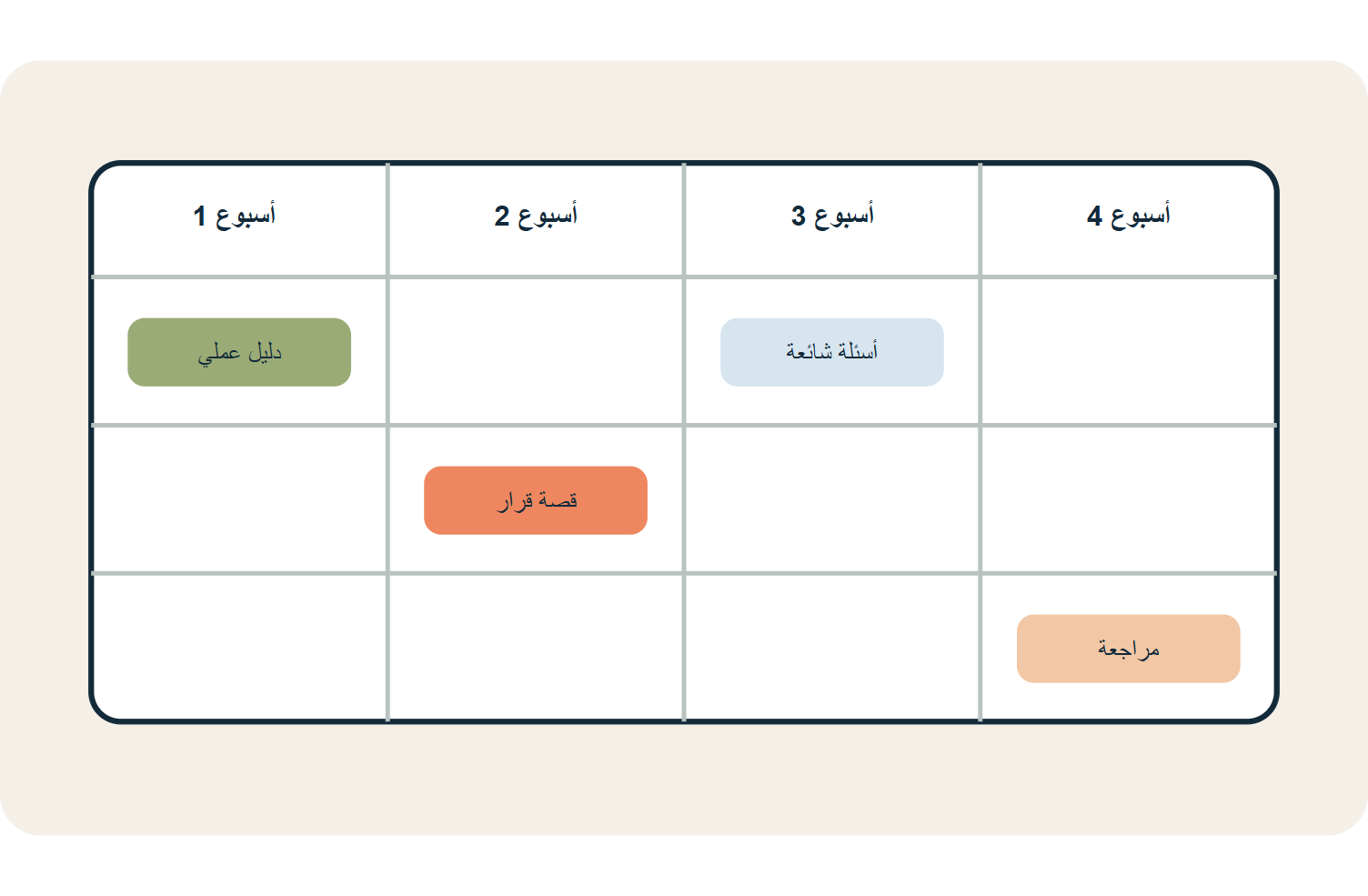
- Week one: one decision question and an article that explains a comparison or preparation step.
- Week two: a visual asset such as a room plan or question table, with a text explanation that works without the image.
- Week three: a case or common mistake, with clear limits on what can be inferred.
- Week four: update a page or rewrite a piece that failed to answer a repeated customer question.
Give each item five fields: purpose, information source, owner, review date, and decision status. Leave room to pause an item when prices, drawings, regulations, or availability change. A calendar is a coordination tool; it is not a promise to publish through changing facts.
Create a review point without freezing the team
Use three gates:
- Fact gate: Are names, numbers, scope, and conditions supported? If a detail is missing, label it unknown instead of filling the gap.
- Reader gate: Does the piece answer one question? Does the reader know the next useful action? Does the title match the body?
- Delivery gate: Are the image, file, Arabic version, and English version ready? Can the owner approve them by a known date?
Keep statuses simple: draft, in review, waiting for information, ready for final review, or paused. Too many labels make the team debate vocabulary instead of solving the issue.
Connect content to a landing page without overclaiming
If an article helps someone prepare for a viewing, the next page should explain what the viewing includes. If it compares a material, the next step should show what can actually be compared. This is not a promise that a link will produce a sale; it is a way to reduce the gap between a question and a decision.
Before adding a call to action, complete this sentence: “After reading this, the reader still needs to know ___.” If the answer is a page or form, check that it describes the real scope. If there is no useful next step, finish with a practical checklist instead of adding a decorative button.
Measure useful signals without claiming causation
Record descriptive signals: questions repeated in calls, pages people read, checklist downloads, or revisions requested by sales. These signals help choose the next topic; they do not prove that one article caused a specific lead.
For SEO, first check that the page is understandable, readable, and titled accurately. Google’s guidance emphasizes helpful, people-first content and says there is no magic word-count target. For paid advertising, the ad message should match the page the visitor reaches; a page that does not deliver the promised information creates friction even when the ad is attractive.
A pre-release checklist
- Is the decision the piece serves clear in the first two paragraphs?
- Is the theme tied to a real sector and operating step?
- Does every important claim have a source or a visible limitation?
- Is the language easy to read on a phone?
- Does the image teach something, and does it have useful alternative text?
- Are Arabic and English independently written rather than mechanically translated?
- Does everyone know who reviews the item and when?
- Is there a stop condition when the facts change?
- Did the draft avoid unverified numbers, prices, and performance promises?
A practical start for this week
Create a one-page map: one client decision, three themes, five voice rules, and four calendar items. Review it with one person who knows the customer and one who owns delivery. If they disagree, do not rush into more writing; repair the map first. A content strategy becomes valuable when the team can use it on an ordinary Tuesday, not when it looks impressive once.
To turn the idea into an executable calendar, read One Brief to a Monthly Content Plan: Template & Steps, then use the Monthly Marketing Plan when the team needs a steady review rhythm.
Evidence and limits
- Service scope used: themes, voice, and a calendar that any writer can follow.
- Keyword Planner observation: “Content strategy,” Egypt, English/Arabic planning context, Google, last 12 months through 2026-09; the Arabic seed row showed 10–100 average monthly searches with low competition. This is a dated, market-specific range, not a traffic or ranking forecast.
- Target market in this brief: Egypt, Saudi Arabia, and the UAE; sector: property, real estate, and interiors.
- Google Search Central SEO Starter Guide: https://developers.google.com/search/docs/fundamentals/seo-starter-guide
- Google people-first content: https://developers.google.com/search/docs/fundamentals/creating-helpful-content
- Google Ads landing-page guidance: https://support.google.com/google-ads/answer/6238826
- Sources define general working principles; they do not establish MartGain pricing, delivery times, or performance.
- No unverified prices, results, or guarantees are included.
Arabic companion: استراتيجية المحتوى للعقارات والتصميم الداخلي: من الفكرة إلى خطة يقدر الفريق ينفذها. This is an independent English rewrite, not a literal translation.
Services related to this article
If you want to put this into practice, these are the closest services.
You may also like
-
 SEO & Visibility
How to Link Articles to Services Without Stuffing Links | MartGain
* How to Connect Articles to Services Without Link Stuffing. A practical MartGain guide to clarify the decision, check the evidence, and define a useful next… -
 SEO & Visibility
What Should an SEO Audit Check Before New Content? | MartGain
* What Should an SEO Audit Check Before New Content?. A practical MartGain guide to clarify the decision, check the evidence, and define a useful next step… -
 SEO & Visibility
How to Choose Keywords with Limited Data: A Practical Framework | MartGain
* How to Choose Keywords When You Do Not Have Enough Data. A practical MartGain guide to clarify the decision, check the evidence, and define a useful next…