Short Video Edit or Full Ad Production? How to Scope the Right Deliverable
* Short edit or full ad video: which deliverable fits the goal?. A practical MartGain guide to clarify the decision, check the evidence, and define a useful…
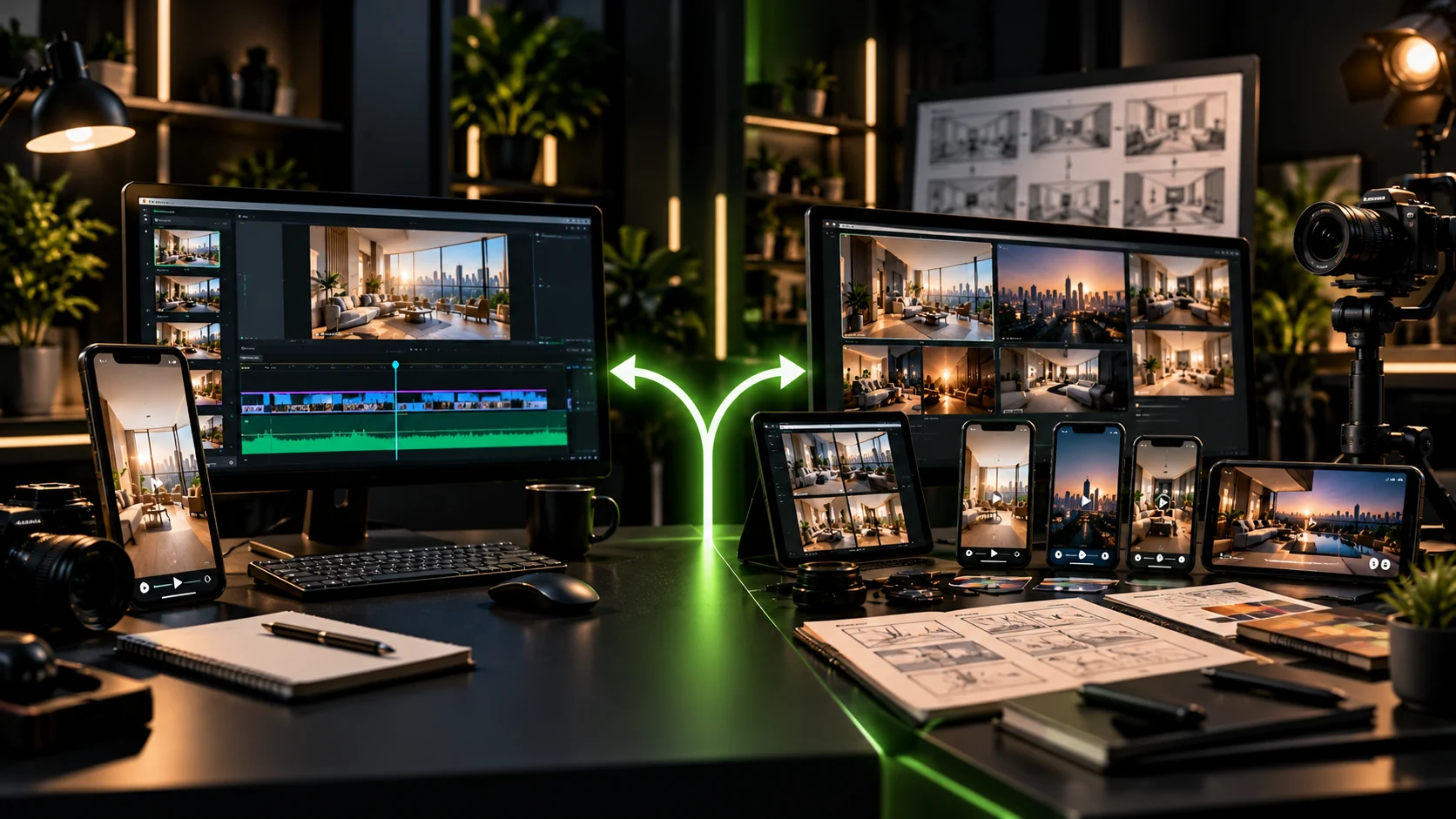
Before asking “How many seconds?”, ask “What must this video achieve—and which pieces are already available?” A 20-second asset can be a straightforward edit or a substantial production if it needs a new message, rights clearance, filming, and multiple approvals. This guide provides a decision framework that turns an ambiguous request into a clear scope of work.
For the wider decision context, read the guide to accurate publish-ready property cuts before approving the next version.
Start with the desired action, not the runtime
Define the viewer’s next action: understand a demonstration, remember a tip, send an enquiry, visit a landing page, or book. An edit can include a CTA, and an ad can reuse existing footage; neither feature alone automatically determines the scope. The determining factor is the amount of development, production, and asset management required.
Before seeking bids, answer four questions. Does the message already appear in the raw footage? Are the audience and placement set? Is the destination approved? Do you need separate variants, languages, or compliance reviews? Keep unresolved answers as dependencies rather than silently including them in a quote.
When footage exists but the message is unclear, request a source-footage assessment first. Editing can sharpen proof; it cannot invent missing proof.
What separates a short edit from full ad production?

A short edit primarily turns existing materials into a usable deliverable: selects shots, removes repetition, shapes timing, performs agreed audio work, adds captions or graphics, and exports named files. A new creative concept or filming is not included unless expressly listed.
Full ad production starts upstream of the timeline: who is the audience, what credible promise is made, what demonstrates it, what action should follow, and which placements are required? This may lead to scripting, storyboards, sourcing or filming, editing, variant production, and approvals. A contract can include some of these tasks without the others; “full-service video” is not a specification.
What belongs in a short-edit quote?
Specify the supplied materials: original file location, sound and image quality, length, language, brand files, and excluded shots. Describe deliverables in files rather than vague shorthand: for example, “one vertical cut with English burnt-in captions and one clean version,” with agreed frame size, format, and delivery date.
Define review rounds, how feedback is consolidated, and whether revisions cover timing and text or a fresh concept. Exclude new filming, original voice-over, advanced animation, landing-page production, paid-media management, and community replies unless named in the quotation.
A quick source review is valuable when footage completeness, licensing, or technical quality is unknown. “Editable” does not automatically mean “cleared for use in an advertisement.”
When does a campaign need a fuller production?
The project expands when the concept, script, or proof still needs development. Start from a single audience and problem, choose a claim supported by the asset, specify how that support will be shown, and confirm the CTA destination.
Assign an owner for factual claims, brand consistency, licensing, and paid-media review where relevant. Targeting, ad spend, landing-page analytics, and ongoing optimization are separate services unless explicitly contracted.
If you need multiple audiences, languages, or placements, list the variants. Resizing one master export is not always adequate when text, framing, or the action needs to change for the placement.
A decision matrix before paying a deposit
Use the comparison below as a scoping tool, not a rate card. Each cell is negotiable. Mark every dependency as available, required, or not applicable before asking for a binding price.
Never present an invented price benchmark. Compare competing bids only after each supplier quotes against the same deliverables and exclusions.
| Item | Short edit | Full ad production |
|---|---|---|
| Primary purpose | Clarify or strengthen supplied footage | Persuade a defined audience toward a specific action |
| Start inputs | Usable footage, existing message, brand files | Brief, approved claim, evidence, CTA destination |
| Scripting/filming | Excluded unless explicitly added | Included only when itemized in scope |
| Deliverables | Named cuts, ratios, languages and captions | Master plus approved placement-specific variants |
| Approvals | Defined review owner and revision rounds | Concept/script approval before final creative approval |
| Rights | Client supplies materials licensed for the use | License or ownership defined for every asset |
| Usually out of scope | Ad management, new filming, landing page | Targeting, media spend, reporting unless agreed |
Two fictional scenarios that change the decision
Scenario A — short edit: A retailer has a complete product-unboxing demonstration with a clear proof shot. They need one organic platform post, captioning, and a licensed music track if desired. The editor can shape the existing material without inventing a product claim or arranging a new shoot.
Scenario B — full ad asset: The same retailer now requests paid creative for two audience groups, with different messages and campaign links. The team still needs a signed-off script, a proof shot, suitable visuals, and any necessary disclosures. This is a wider production because the deliverables changed—not simply because someone used the word “ad.”
Both cases are hypothetical illustrations, not customer work or measured performance results.
A copy-ready scope-of-work specification
Define the actual files the supplier will deliver. For example: “One vertical MP4 at the agreed dimensions, one clean export without text, and a thumbnail if separately listed; one review link and two rounds of revisions on the first cut.” This is example contractual wording, not an industry standard.
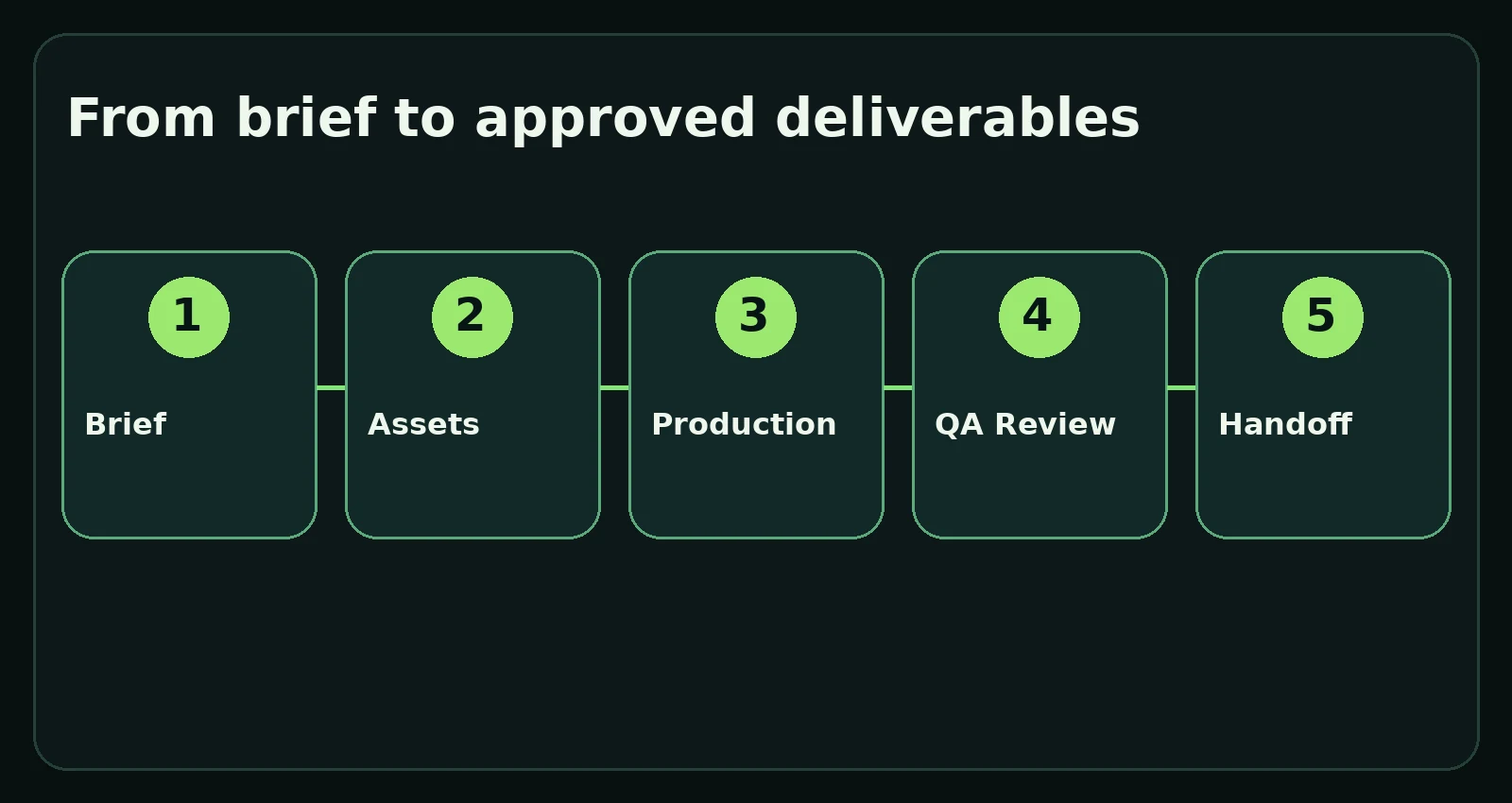
Your scope sheet should record project, audience, desired action, message, supporting evidence, destination, source assets and rights, versions, ratios, languages, captions, review gates, revision rounds, delivery format, and decision owner. Include an approval date and a written change-request process.
If the buyer adds an audience, language, shoot, or campaign destination after sign-off, document the impact on timing, cost, and outputs as a new change request before work begins.
Platforms and formats: what must be checked?
Google Ads’ official video specifications list placements that use horizontal 16:9, vertical 9:16, and square 1:1 formats, with details changing by campaign type and inventory. That guidance applies to Google Ads; it is not a universal requirement for every platform. [C01]
Before exporting, specify the publishing account and exact placement. Check that platform’s current official guide and preview tool for framing, cropped elements, UI overlays, and safe areas rather than assuming one fixed margin across services.
Review rights to footage, music, fonts, and marks. Verify any prices, performance claims, or testimonials in the final file. Eligibility for a placement does not promise campaign performance.
The final review and acceptance checklist
Review the export on a real phone, preferably with the approval owner. Can the narrative be followed when muted if captions carry the meaning? Are captions free of errors? Do the opening and final action make sense? Does the destination open? Are rights and required disclaimers cleared?
Match each asset against the variant schedule: ratio, language, captions, logo, clean version where agreed, and filename. Record defects and retest the corrected file; rights or unsupported claims are not cosmetic defects.
Use three outcomes: accept when every critical condition is met, rework when an issue is fixable, and hold when a necessary right, fact, or approval is missing. Sign off only the identified final version.
Prepare the footage or brief, list the deliverables, and request a quote that explicitly names revision rounds and exclusions. The MartGain service page may be used as a starting point after confirming that it is active and accurate.
MartGain video editing services
This service URL was present in the supplied article and could not be independently opened during this audit.
Sources and limitations
[C01] Google Ads Help — Video ads specs and format requirements: https://support.google.com/google-ads/answer/17091270?hl=en
[C02] Google Ads Help — Use square and vertical video: https://support.google.com/google-ads/answer/9128498?hl=en-GB
[C03] Google Search Central — Creating helpful, reliable, people-first content: https://developers.google.com/search/docs/fundamentals/creating-helpful-content
Services related to this article
If you want to put this into practice, these are the closest services.
You may also like
-
 Content & Social
Newsletter Signup Form Checklist: UX & Confirmation | MartGain
* Newsletter Signup Form Checklist for a Trustworthy Brand. A practical MartGain guide to clarify the decision, check the evidence, and define a useful next… -
 Content & Social
Bilingual Newsletter Form QA: Consent & Confirmation | MartGain
* Bilingual Newsletter Forms: Fields, Consent, and Confirmation. A practical MartGain guide to clarify the decision, check the evidence, and define a useful… -
 Content & Social
Writing Original Arabic Copy Beyond Literal Translation | MartGain
* How to Write Original Arabic Marketing Content Instead of Literal Translation. A practical MartGain guide to clarify the decision, check the evidence, and…